
News Center
Ideas and Insights for Better Living
A low factory quotation can become an expensive housing project when the delivery truck cannot reach the site, lifting equipment must travel from another town, or the installation crew arrives before foundations are ready. For remote sites, these gaps affect both the budget and the date accommodation becomes usable.
Compare Flat Pack Container Houses on total installed cost for the same ready-to-use scope, not unit price alone. Add transport, unloading, site works, assembly, utility connections and location-specific requirements to each quotation. Keep unresolved costs visible rather than treating exclusions as zero.
Start by defining what the factory price includes
A quoted “house” may mean a structural kit, a weather-tight enclosure, or a fitted unit with internal electrical and plumbing components. Those are different purchasing scopes. Request an itemized supply list covering frames, panels, flooring, roofing, doors, windows, insulation, seals, fasteners and interior fittings.
Clarify whether electrical and plumbing items are supplied loose, factory-installed, or excluded. Factory-installed wiring does not necessarily include the site distribution board, incoming power connection or local inspection. Internal plumbing does not provide a water source or wastewater system.
The last mile can change the transport plan
Compact packing can reduce shipping volume, but it does not guarantee inexpensive remote delivery. Obtain package dimensions, individual weights, stacking limits and unloading requirements before asking carriers for prices. Confirm the actual packing arrangement rather than assuming every kit travels in a standard shipping container.
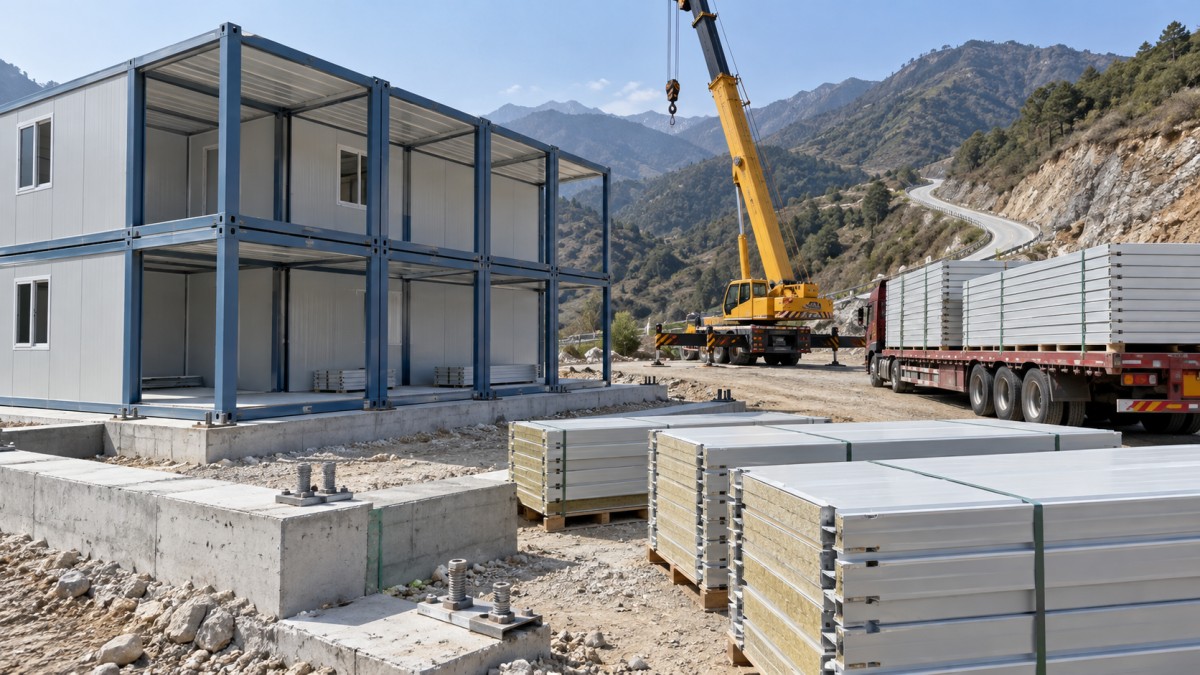
The route assessment should cover bridge capacity, road width, turning space, overhead clearance and seasonal access. A large truck may reach a regional depot but not the final site, requiring transfer to smaller vehicles. That adds handling, equipment hire and potential damage exposure.
Ask freight providers to identify destination handling, storage, waiting time and any container detention or demurrage charges separately. Confirm the named delivery point and who handles customs clearance, insurance and unloading. “Delivery included” is insufficient when it ends at a port rather than the installation area.
Price the ground conditions before booking installation
Flat-pack accommodation still needs a suitable supporting base. Surveying, clearing, grading, drainage, foundations and anchors can become substantial costs where the ground is sloping, soft or difficult to excavate. A foundation allowance based only on unit dimensions may miss soil conditions and local structural loads.
Obtain the supplier’s support-point layout, reactions and anchoring requirements, then have the foundation design checked against the site conditions and applicable requirements. Also allow space for unloading, equipment access and temporary material storage. Without a usable work area, crews may need to move components repeatedly before assembly begins.
Assembly labor is only part of the installation bill
Installation quotations should state the crew size, assumed productivity, equipment requirements and excluded tasks. Remote work may require travel, accommodation, meals, temporary power, scaffolding and lifting equipment mobilization. Equipment charged for a minimum hire period can remain costly even when lifting takes little time.
- Check lifting requirements: Ask for component weights, approved lifting methods and equipment access needs before choosing a crane or forklift.
- Confirm crew capability: Available labor may not have experience with panel joints, waterproofing details or the specified electrical system.
- Include commissioning: Budget for connection checks, water-system testing, electrical testing and correction of installation defects where required.
- Plan for shortages: Confirm fastener quantities, sealant specifications and a spare-parts allowance; a missing connector can delay work far from supply stores.
Request assembly drawings before placing the order. They help the installer identify tasks that depend on specialist trades and clarify whether supplier guidance means documentation, remote support or an on-site supervisor.
Utilities and climate requirements can alter the specification
Where mains services are unavailable, the budget may need to include power generation or storage, water tanks, pumps and wastewater treatment. Size these systems around occupancy and actual loads, including heating, cooling and hot water. Check starting loads as well as normal consumption when selecting power equipment.
Climate suitability should be resolved before comparing prices. Insulation performance, condensation control, corrosion protection and wind or snow resistance may require changes to the quoted specification. Request documented design limits and confirm suitability for the location; an unspecified “standard” unit is not a reliable cost baseline.
Make remaining uncertainty visible in the purchase decision
Build a comparison sheet using identical quantities, specifications and completion boundaries. Mark each cost as a firm quotation, an allowance or an unresolved exclusion, and assign responsibility for every interface between supplier, carrier and installer. Avoid double-counting tasks already included in another contract.
Use a project-specific contingency tied to identified risks, such as seasonal road closures, uncertain excavation or delayed utility access. Before releasing the order, prioritize closing the gaps that could stop deployment altogether: route feasibility, foundation requirements, unloading arrangements and service availability. A higher factory price may be justified by included work, but only when that scope demonstrably replaces another budget item.
Navigation
Send Us A Message
Drop a Message